Thursday, June 3, 2010

20 years and still going strong

It's kind of funny and also a little wrong that esposas, the word for wives, also means handcuffs in Spanish.

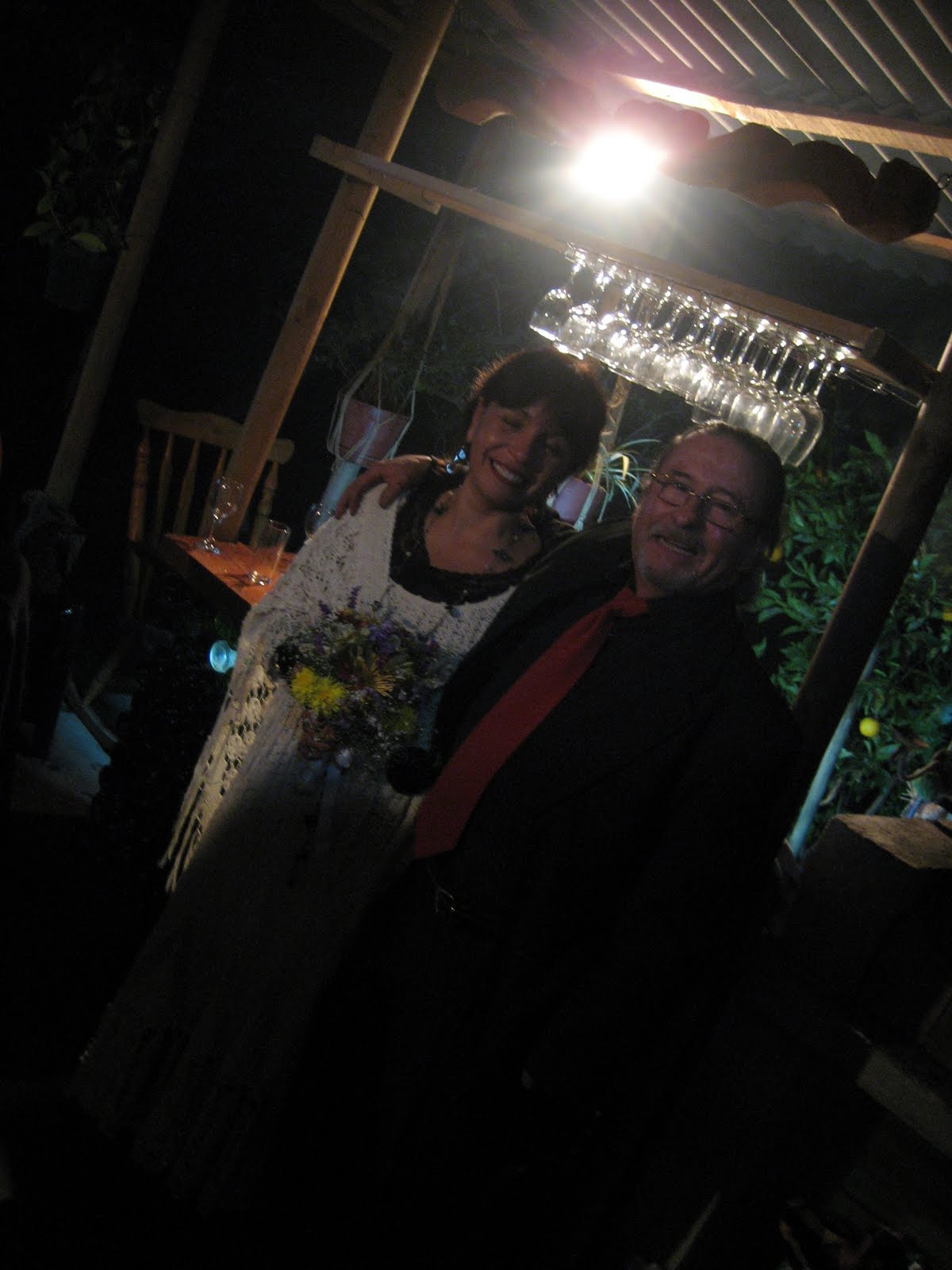
Charo and Norman had a 20th wedding anniversary asado thrown for them by a group of their close friends.  Our backyard was all set up with flowers, white table cloths, candles, and of course, a massive buffet of grilled meat and sides.  The party started at 6:30pm meaning the guests arrived at a very Chilean time of  7:30 or later.  Next-day reflection counted about 53 total attendees at the asado.  The two never had a formal wedding and reception and had tied the knot at the city municipal building with a government official present for the certificate signing.  And so this was their chance to celebrate the way they would have had there been a party that night twenty years ago.
The novia and novio
Backyard asado patio
Meat on the grill
Choripan of course!

The novia, meaning bride-to-be and as Charo was calling herself all night, wore a white dress and carried around a bouquet of flowers while Norman, the novio, pranced around the backyard socializing with their friends.  Almost every person brought a gift along with a bottle of wine and so the drinks were plenty.  After the big meal, the two read aloud a conversation consisting of love letters they had sent to each other during their courtship, or something to that extent from what I could understand in my limited Spanish.  That, or they were their wedding vows.  Either way, it was thoroughly romantic and all the listening crowd could do was sigh, smile, and clap.

Next, my host brother, Amaury and his friend, Cristobal, played a song on the guitar and charango respectively while host cousin, Santi, did a dramatic reading that I unfortunately couldn't understand but I assumed had something to do with love and devotion.  The entire extended family is extremely artistically talented, made up of painters, needlecrafters, musicians, and actors.  After their performance, it was time for the removal of the garter from the bride's leg.  Yes, you read that correctly.  Norman pulled the garter off of Charo's leg and proceeded to put it on his head and dance around with his signature grin of mischief.  The whole thing finished up with the bouquet and garter throwing and ensuing wrestling match for the flowers.  Then, as Chilean parties go, the dancing and music extended into the wee hours of the morning until everyone left exhausted but happy.

Friday, May 28, 2010

ocean, desert, gringos, and arturo prat

The Pan-American Highway along the coast of northern Chile in the Atacama Desert

Town of Taltal

Chile is long.  About 2,672 miles (4,300 km) long to be exact.  I live in the central part of the country and so it makes it a tiny bit easier to get to places either north or south.  I say tiny because a trip up to the norte grande region of Antofagasta still took me fifteen hours by bus - and that wasn't even really far north to Arica.
May 21st is a Navy holiday in Chile celebrating their victory in the Pacific War against Peru and Bolivia and resulting in Chile taking a good chunk of coastal territory from the two countries, something they are still pretty sour about.  However, this holiday specifically commemorates Arturo Prat, a commander in the navy during the war and the Battle of Iquique.  Long story short, Prat commanded the wooden warship, Esmerelda, which got pummeled by the Peruvian navy.  Prat then climbed aboard an enemy ship and valiantly fought the opposing forces with a just a sword and a revolver against muskets and cannons.  He was shot in the forehead and killed instantly and Chile went on to lose the battle.  His actions spurned a wave of nationalism that was henceforth marked by the date of May 21st.  Leave it up to Chile to celebrate an embarrassing battle lost.

The death of Arturo Prat.
Tragic, but we got a long weekend out of it.  And sword vs. muskets--not the best combat strategy.

And so a group of northern volunteers, all of whom I hadn't seen since training in Santiago, decided to have a little reunion in the little desert coastal fishing town of Taltal where Mike and Vanessa live.  Joining in were three other far north Region Antofagasta volunteers John, Ryan, and Matt, and two norte chico, Region Coquimbo vols, Peter and Alex.  I was the furthest south of the group, coming from Region Valparaíso via the hefty fifteen hour bus trip.  Luckily, it wasn't completely solo because Peter was able to meet me on the bus at hour #5 when it passed through Coquimbo at 4AM.
Eventually, each having trickled in over 24 hours, all eight of us took over the little town together which probably had never seen so many gringos at once ever, as evidenced by the constant stares we got.  But Taltal had a pleasant, quaint feeling and all the locals were friendly, the seafood was fresh, the company was good, and there isn't quite anything like being in a place where desert meets the ocean.

Rather than chronicling everything we did in a long, drawn-out  journal entry, I'll just list some highlights of the weekend.  I apologize that some of these would only be understood by those who were there.

-Seeing "Bienvenidos a Taltal" sign after 15 hours of bus lethargy

-Being fed a plate of fresh abalone for lunch at Mike's house after meals of peanuts, alfajores, juice, and cookies on the bus
-Getting the grand walking tour of Taltal that took all of 30 minutes from one end to the other, including a stop at the plaza fountain
-Peter posing next to the fountain to make it look like the water was spouting from...well, you know

-Mike's host family's family portrait in which the faces of all five members were super-imposed in front of a sunset picture of the now defunct crane at the town beach and in which his host dad, Alejandro, is a spot-on twin of Osama bin Laden, as pointed out by host brother, Nacho

-Vanessa's family's absolutely insane, but very well-dressed poodle
-Walking between dry desert hills and crashing ocean waves
-Being a little late to pick up Matt from the bus stop at 10PM and seeing he had already made a friend with a street dog while waiting for us
-Random drive to the beach at 1AM because that's just what they do
-Watching Mike and his buddies surfing in the morning
-Hearing Vanessa sing a tribute song to Arturo Prat in Spanish in front of the entire town while girls from her school did a choreographed dance

-Mountains of asado meat with Mike's family
-Hearing about the wonders of Calama from John
-Listening to Alejandro's stories of his adventures with South American women while Marta, his wife, made disapproving grunts as she washed the dishes behind him
-The three P's of Chile
-The two lies of Chile
-Sketchy dude Vanessa saved me from in the empty discoteca
-The strip show, bar fight, and sudden closing down of the crowded discoteca the next night
-Drunk dude drooling onto Mike's pants outside the discoteca
-The bathroom at Israel's house
-Peter, Vanessa, and I all passing out while watching Glee on Nacho's twin-sized bed
-Impromptu baseball game with random big Chileno using an exhaust pipe as a bat
-Alex disappearing
-Alex jumping out of a tree
-See-Sawing
-Sunset coastal walk to the western lookout point of Taltal

-Saving Ryan from the birthday girl at the carrete
-Peter being a good wingman and sacrificing his own personal space to save Ryan from the birthday girl while the entire party looked on through the picture window into her room
-Staying out until 8AM two nights in a row
-Being served tuna sandwiches at the end of the party around 7AM
-Alex hanging out with 16 year-old girls at the beach
-Vanessa's amazing massages
-Gringo ambushing both Mike's and Vanessa's classes in school
-7+ people being squeezed into tiny cars circus-clown style more times than I can count
-A solid weekend of gringos trying to be Chilenos and maybe doing pretty well with that

Wednesday, May 26, 2010

the causes of illness

For those of you who know me well...no...have met me ever, you know that I tend to not wear shoes whenever possible.  I hate shoes, socks, or any form of enclosing my feet and only do so to keep from stepping on syringes, getting frostbite, or getting fired.  In an Asian home, that's great, perfectly fine, and actually good manners.  In a Chilean home, it's a health hazard and I will surely catch whatever diseases and sicknesses are lurking on the floors ready to seep into the balls of my feet.  And no, flipflops and socks won't keep them at bay, I need full out soled shoes in order to avoid being enferma.  This was possibly the biggest hurdle for me and I still haven't fully complied with it, partly out of a bit of resistance and partly out of pure forgetfulness.  I'm constantly being scolded by Charo with a stern look at my feet, a tsk tsk wave of her finger, and a motion of rubbing her neck, representing the sore throat I will surely get.  Of course, it's the barefeet that will make me sick and not the open doors and windows until bedtime because the enclosed space will breed more germs.  And just so you know, fall and winter nights in the central regions are on average around a balmy 40 degrees Fahrenheit.

On my second day at the house, Charo gave me these pantuflas made by an artisano from Valdivia to cover up my feet.

Wednesday, May 12, 2010

los andes to the east, el pacifico to the west

Parque La Campana is a national park just east of my town of Quilpué marked by its main attraction, Cerro La Campana, a 6,168ft (1,880m) peak where from the summit on clear days, you can see the Pacific Ocean as well as Mt. Aconcagua, the tallest point in the western and southern hemispheres.  In 1834, Charles Darwin climbed La Campana and his ascent is commemorated by a plaque near the summit.

Well, a group of us Region V volunteers decided to climb this mountain as well, and while we didn't get a plaque embedded in rock in our honor, we got some pretty incredible pictures and quite a workout during both the climb and descent.  After staying overnight in a hostel in Olmue, the town outside the park, we headed out bright and early for the hike, geared with lots of layers for the changing temperatures of the day and the altitudes, water, and peanut butter and jelly sandwiches.  At first, the trail started out peacefully through the woods and over a winter-dried river but the further we climbed, as did the steepness of the slope and soon, the trail was mostly cutbacks through the trees.  Every so often, a break in the canopy showed a beautiful view of the valley we left behind, and where Annamarie, Brandy, and I live, Limache and Quilpué.  It being fall in the southern hemisphere, the trail was lined with foliage reminiscent of October in New England.

After about three hours of forest hiking, we reached an old mine where there was a campsite and a semi-reliable water source.  We had been told by the park ranger not to fill our bottles in the restrooms at the base because it might not be the cleanest.  There were a few Chilenos up here who we found out, after a quick chat, had climbed to this point overnight, pitched their tents in the dark, and climbed the last two hours at dawn to catch the sunrise from the summit.  We also found out that the trail for these final two hours of the hike was closed after the earthquake as it was mostly climbing over treacherous rock fields that had shifted when the earth moved.  We had actually heard about this beforehand but wanted to scope out the situation for ourselves.  After talking to other hikers along the way who had made it to the top and who confirmed it was safe enough, we decided to go for it.  Why go all this way and not make it to the top?  Then they also told us it was only dangerous if there happened to be a tremblor, or aftershock, while we were on the rocks.  All we could do was hope that the earth would stay still for a few more hours.


And that it did.  After two more hours of almost pure rock climbing, we stepped up onto the relatively small, bald cumbre of Cerro La Campana.  With the air crisp and the sky luckily as clear as it could possibly be, we surveyed the land around us.  The valley towards the west where the blue of the Pacific could be made out, the Aconcagua Valley and snow-capped Andes with Mt Aconcagua towering above the rest visible to the east, and the rest of the coastal range running north to south along the Chilean coast were all worth the five hours of work we put into our thighs and feet.  It was amazingly quiet and just one of those places you could sit for hours which is what we would have done had it not been for the need to beat the sun back down the mountain in a few hours.  After our lunch of sandwiches and plenty of picture taking, we hustled in three hours back down the mountain, running into a few wild tarantulas along the way, and making it back to base just as it was getting difficult to see one foot in front of the other.  After we hitched a ride with a couple of kind Chilenos (all eight of us packed into the bed of their pickup truck) since the wait for the next bus was half an hour or more, we arrived back in Olmue centro ready for a full meal, a hot beverage, and a foot massage.


Saturday, May 1, 2010

no reservations chile: WATCH IT.

Anthony Bourdain did an episode on Chile a little while ago and not only is it a great introduction to the food, but a really interesting and informative depiction of Chilean history and culture.

If you want to watch, here are the links to the episode on YouTube. It's in 5 parts. Enjoy!!!


Wednesday, April 28, 2010

lots of people in the south love watching tectonic plates

The language barrier can be really frustrating at times but having already moved to two countries without knowing the languages first, I've generally learned to stay relaxed and shrug off inabilities to communicate. It's especially comical now because I'm in a stage where I can understand enough to get the gist of some conversations, but a lot of times it's not quite the right gist and I end up chiming in with some kind of awkwardly composed, remotely-related answer. The Spanish is coming, but 80% of the time, I still have no idea what's going on. It doesn't help that Chileans speak a million miles an hour, slur/cut short their words, and have an entire dictionary full of chilenismos, only-used-in-Chile idioms.

Ayun was working on some kind of project with Styrofoam after once last night and I asked Charo what it was about. Charo can't speak any English but she's pretty good at explaining things in simpler Spanish until I can understand it for the most part. So she told me what Ayun was doing, and I couldn't make out the meaning on the first couple of tries. My comprehension of simple Spanish has soared compared to what it was (nothing) before I moved in, but it was more specialized language about the topic of the project.
On another try, I caught the word "Nascar" and was a little bewildered that she would be doing a project on race car driving in the US but hey, this is Chile so who knows. In Spanish, I said, "Nascar?? Why is she doing that topic? That's interesting. Nascar is very popular in the south of the United States and many people love watching it. Not in the north though."
Charo just looked at me a little confused, then just smiled and shrugged her shoulders. And that was that.

Today, Ayun was working on it again in the kitchen and preparing a map of the world to stick onto the styrofoam, which Norman was helping her cut into the shapes of countries with a hot butter knife. At first I thought, how is this related to Nascar, but then just decided to sit back and watch. Finally I asked Ayun what she was actually working on and she told me a history project on placas tectonicas (tectonic plates).

Ohhhhhhhhh...ok. Then why did Charo tell me Nascar?

Then Norman started talking about the plates under Chile that caused the 8.8 earthquake a few months ago and mentioned the name Placa de Nazca very quickly. Having just read about these plates under Chile when I posted on the geography a little while ago, it clicked.

So I had told my host mom that tectonic plates, specifically the Nazca, were very popular in the south of the US and people love to watch them.

She must have thought I was out of my mind and in a way, I guess I was.


Tuesday, April 27, 2010

tienes un pololo?

My school is basica level which means it has grades K-8. Each grade is split in half and so has two classes of about 40 kids each. My co-teacher, Angela, sees each one once a week for 90 minute blocks. The last couple of weeks, I have been meeting all the classes which consisted of me standing up front and the kids asking the same questions over and over from class to class (in Spanish of course because why would you speak anything else in English class?)

"How old are you?"
"Where are you from?...USA?...Not China?"
"What's it like in the USA?"
"Do you have siblings?"
"Do you have pets?"

"Can you speak other languages?"
"What's your favorite color?"
"Who is your favorite singer?"
"How's the food in the USA?"
"Do you know other countries?"
"Were you here for the earthquake?"

And my personal favorites...

"Do you know Obama? In person??"
"Do you know Michael Jackson?" (always accompanied by a quick Jackson dance move)
"Do you know Jackie Chan?" (always accompanied by a karate chop)
"Do you know kung fu?" (also accompanied by karate chop)


School courtyard

I decided to have a little fun with a couple of classes and told them that I was actually friends with the Jonas Brothers and Selena Gomez (Disney Channel kids). I got a lot of jaw-drops and shrieks from the girls and even more questions about these people I know nothing about. Hey, if it means respect, why not?

"Do you have a boyfriend?" ("Tienes un pololo?")

This is usually asked by the boy who is most likely the big shot in class.
If you answer this question with "no," you're met with confused stares and, "well...why not?" because in Chile, it's just expected that you have a significant other. If you don't, there must be something wrong with you.
If you answer this question with "yes," said-boy gets the "too bad for you" punches in the arms by his buddies and he sheepishly smirks while all the girls giggle.
The English level is generally pretty low in all the classes, though some lower than others. For example:
Angela: "Good morning, children."
Class: "Good morning, Miss Angela."
Angela: "How are you?"
Class: "How are you...?" or "Good morning" or "...."
However, my segundo B (2nd grade, B) class welcomed me with this lovely greeting:

Monday, April 19, 2010

mi familia chilena

Mi padre, Norman

Mi madre, Charo, y mi hermana, Ayun

Mi hermano, Amaury (right), y su amigo, Cristobal (left)

Nuestra nana (our housekeeper), Lily

La familia (sin Amaury) eating once ("on-say"), the Chilean version of dinner

Sunday, April 18, 2010

my new life in quilpué

After our WorldTeach group split up to our new homes, we each wrote an update to everyone about our placements, families, towns, and schools. This is the email I sent:


Hola! to my wonderful posse,

I am writing from my lovely little house (yay wifi!) in the suburbia of Valpo. I have an awesome family that seems to be pretty influential in this town (the mayor is a close friend who gets drunk and crashes on their couch at their weekly Sunday asados):

-my dad, Norman, works for the Mineduc and also was a former prisoner of Pinochet
-my mom, Charo, is the sweetest woman, a great cook, and her last name is Allende...(relation maybe!?) Neither parent speaks a lick of English save for "beautiful" and "Oh my God!"
-my 17 year old brother, Amaury, has the intelligence and wisdom of someone way beyond his years, speaks really in-depth English, and is a talented musician
-my 12 year old sister, Ayun, also speaks some English and is just adorable
-our german shepard named Laica who is a very "special" dog. Just now I called out at her from my window and watched her get really excited, run in circles, and then proceed to lay down and gnaw on a piece of her own stale poo. Yes, "special."

We live in a little 1-story house about a 10-min walk from the centro of town and also near a metro stop on the Valparaiso line (I think it's 20 min from here to Vina and 30 min to Valpo?) The house reminds
me of Pablo Neruda's in that the rooms are each at different weird levels even though it essentially is just one floor. Some walls are painted in different bright colors, some have murals on them of Valpo that the family painted together and the house is covered in cool paintings, tapestries, and objects from all over the world. It doesn't hurt the Neruda association that they have pictures of him all over the place. The best part is the backyard which is full of fruit/nut trees, has a grape terrace, garden, hammock, BBQ pit and is surrounded by tall walls covered in ivy. I've happily discovered the wifi reaches the hammock. They whole place is decorated with what other people would deem trash but they have turned into works of art.

Quilpué itself is just kind of a big sprawl of homes and I've been warned to stay out of some areas. The centro is a small commercial area but the streets are small, the buildings are short, and there are lots of mom and pop shops and bakeries. The whole town is surrounded by hills. Just over the ones my house faces is Vina.

My school is about a 20-min walk from my house, shorter by bike which I'll have after Amaury fixes his up for me. It's grades 1-8 and I'll be seeing them all. My co-teacher and principal both speak some English, enough to communicate fine and I've met most of the kids already. Some are really sweet, some are terrors naturally, but all
of them are adorable. I'm mostly shocked by the lack of classroom management here and how it's just accepted as "Es lo que hay." My schedule after this week of observation will be M, T, W 8am-3pm and W, Th, F 8am-3pm on alternating weeks. Yes, this means every other weekend for me will be 6-day weekends so get ready to show me around your towns!

The only problem is that I currently don't have my own classroom.  I've been pushing for one this week and will be more firm at the end of it before I actually start teaching. The only prospect is the stage in the courtyard that can close up and is only used a few times a month. Everything else with the school is great, it has projectors and boards in every room and has wifi on the whole property for free.  It's a public school but I've been told that the kids who go there are really under-privileged with tough social backgrounds and so they get a lot of donations and funding from the government. But you wouldn't be able to tell this from their energy and enthusiasm.

Anyway, sorry my little update has turned into a 10-page paper. I loved reading about all your places and I will definitely be seeing you all soon! (The ones on the beach probably sooner :)

Muchos besitos,
Tang

¡hacer una gordita!

You may have heard that Chilenos eat a lot of meat and seafood. Well you heard right.

Not all snack foods are created equal. Seafood is a little more expensive and meat generally is not. If you're in between meals and craving something substantial and tasty but light on the wallet, here is a little introduction to just a few of the more popular snacks in Chile that you can find anywhere.

Completo
This is the glorified hot dog of Chile. It typically comes with avocado, diced tomato, and mayonnaise on top and can be further decorated with ketchup, mustard, relish, and chili peppers. You might have seen Anthony Bourdain eat a giant completo in Viña del Mar. If not, you can here. I like to order mine sin mayonesa.

Empanada
These are delicious pockets of golden baked dough filled with anything of your choice. The usuals you'll find in shops are the pino, queso (cheese), jamón y queso (ham and cheese), espinaca (spinach), and sometimes mariscos (shellfish). The pino is considered Chile's specialty and is filled with ground beef, onions, a piece of hardboiled egg, and a whole olive.

Choripán
The choripán is a delicious little chorizo sausage tucked in a bun sometimes with avocado or tomato. This is one of the Chilean people's most beloved foods. Funny thing is, you can't buy them ready-to-eat anywhere. This is because they are usually eaten at asados (BBQs) which are frequent here, where the choripán can be made to the tastes of people grilling them.

Chorrillana
This is the mother of all beastly junk/drunk foods. Imagine a plate about 15in long, piled high with papas fritas (french fries), queso, hot dog/sausage slices, cebollas (onions), and a couple of huevos fritos (fried eggs) on top and you've got the chorrillana. We as a group have decided that there is no way anyone in their right mind would order this, especially eating it solo, but with a group of friends after a night at the bars, nothing tastes better...or feels better in the morning. ;-)